Tags

  • Published on

    Taking Ownership!

    Picture
    Image description
    When I sat down towards the end of last year to take stock, and initiate a very critical approach to what I wanted my life to look like in 2021, it was apparent I needed to take ownership of those targets and goals I set for myself. These things were not just going to happen by magic. But what does taking ownership actually mean? For me, it means not just doing something, but being accountable for all of it and seeing it through to the very end, until it is complete. It means proper planning and preparation, it means careful consideration, it means learning from mistakes, being accountable for every stage of that target or goal. It also means being honest and realistic, especially if something isn’t going to plan or seems unsurmountable at the time (and if that is the case break it down into more achievable parts).

    It also means making certain sacrifices. Sometimes that isn’t easy to do but for a bit of short-term ‘discomfort’ those longer term goals can be achieved. It is sometimes simpler to take the easiest route (part of our brain is actually wired to do that as part of our survival instinct). It was pretty simple to enter the 50k Ultra Trail Run I’m currently training for. Just pop onto the website, fill in my details, pay and enter it. Job done.

    It isn’t job done though.

    I knew that when I hit enter there was no turning back. I had committed to complete that event. I entered an ultra a few years ago, started training, got complacent, got injured, and didn’t take full ownership. It is something that has played on my mind a lot since, and I won’t be at peace with myself until I cross that finish line.

    Now I have to take full ownership – those training runs won’t do themselves.

    I sat down and made a plan.

    How much training I needed to do. How many training sessions I needed to do each week? How long should my runs be and when? What does my recovery look like? What other training do I need to do – Strength? Speed? Core? Other? How do I mentally prepare for it? What kit am I going to need on the day? What kit do I need to do the training? What kit do I currently have? What is my nutrition plan for the race, and what does my diet currently look like? What pace do I need to be running at? Is that the pace for all my training?

    By answering these simple questions I was able to formulate a basic plan, nothing more than that, just a basic plan of where I was and what I needed to put into place.

    Job done? No way.

    I needed to take full ownership of this now.

    I decided that I needed to do my runs in the morning (so it was done and out of the way, I tick that session off and don’t need to worry about it the rest of the day) – it means getting out of bed before 6am and getting out there training no matter what the weather is doing.

    In order to finish the ultra I need consistent training, not when I feel like it, but when it needs to be done, not missing a session because I feel tired, but when it needs to be done. It felt a bit of a slog to begin with but has now become part and parcel of my routine. A little short-term ‘discomfort’ to achieve a longer-term goal. I need to make certain sacrifices in order to achieve that goal, and I’m happy to do that. I’ve taken the same approach with each of the targets and goals I’ve set myself for the year and taken full ownership of each of them as well. Many of them require me to have short-term ‘discomfort’ to achieve them, that is not a problem because I’ve decided that quitting is no longer an option any more.

    I’ve been pretty hard on myself when evaluating what I want to do and how I get there. What do I need to change (then change it), what adds value (then add it), what adds zero value (then get rid of it). I’ve started to fine-tune a lot more, and already I am starting to see some good results of doing so.

    I need to be really mindful that complacency doesn’t set in as that can lead to laziness creeping in gradually, eventually that becomes a downwards spiral, training sessions are missed and the goal becomes unrealistic and unsurmountable, and I’m back to square one again – short-term ‘discomfort’ leads to longer term gains, so quitting is not an option.

    Each and every day I think about what it would mean to cross the finish line of the ultra (and also achieving the other goals I’ve set myself). Each and every day I ask whether I am taking full ownership of my goals and targets.

    Picture
    Picture
  • Published on

    Visualisation!

    Picture
    Image description
    One of the areas I learned to focus on quite a few years ago when training for endurance events was visualisation. I would sit down quietly in the corner of the room, close my eyes and focus on a part of my training or a race that would be competing in soon. I would focus and visualise on how I feel, my technique, feeling strong, my power output, and my pace. It was something I felt really worked and allowed me to concentrate on the mental aspect rather than the physical aspect of training. It also gave me that sense of belief.
     
    I’m currently training for a 50 km ultra trail run and a vision keeps on appearing in my mind – I am running smoothly along the trail, my pace is good as I leave a forested section of the trail, it is warm, it is sunny, and I can see the next 5-6 miles of trail ahead of me. I’m feeling strong and motivated and know if I complete this section of trail I will be much closer to the finish line, all I need to do is keep moving forwards. I am aware of the surroundings of my environment even though I am solely focused on reaching the finish line.
     
    I was out for a run on Saturday morning. I didn’t have a mileage in mind apart from the need to do my longest run of the year so far. I set out, and it was pretty blustery in places, then a change in direction and a solid headwind. It is tough and although the pace had dropped the effort had increased to push forwards. I’m fully focused and the visualisation comes into my mind and running along that trail towards the finish line. The next couple of miles seem to flash by. By the time I get back, I’ve run just over 11 miles (my longest run this year) and I feel like I could have run much further than I had.
     
    I reflected on that run a bit later in the day. I seemed to zone out for a large part of the run – I was focused on moving forward, running at a steady pace, was focused on my breathing. How fast and how long I had run wasn’t an issue and not something I’d thought about during the run. That sense of belief came flooding through – no longer was it a case of getting to the start line of the 50k ultra, it had now shifted to how I would feel crossing that finish line of the 50k ultra.
     
    When we set ourselves goals or targets that sense of self-belief is important. Visualisation plays a huge part in that. Do you see yourself in that mental picture of what you are setting out to achieve? What does the journey look like? How do you feel when making that journey? Do you rehearse any of the journey? What are some of the pitfalls or obstacles and how you might overcome them? If we can visualise ourselves achieving something, we are more likely to achieve it in reality. It positively reinforces our sense of self-belief.
     
    For me personally visualisation is key. It builds the self-belief, it creates that confidence, it feeds the self-motivation, and builds the resilience required. I know that when the going gets tough I have the mental strength available to keep going. I keep going because I have that inner belief. I keep going because I tell myself over and over that quitting is not an option available.

    I know the nature of endurance events throws up many challenges and some of those are way out of my control. I know that the preparation I do is more than the physical training – the miles run – it is the mental training as well, being prepared mentally, being able to be fully focused, being able to deal with set-backs, being able to tough it out, being able to shut out those negative thoughts, and having that unbreakable sense of motivation to get to the finish line. Like the physical aspect of training it requires constant work, constant practice, and constant fine-tuning until it becomes a behaviour and mind-set.

    Picture
    Picture
  • Published on

    Making Change Happen!

    Picture
    Image description
    The universe is a vast and a very hostile, uncaring environment, which lacks compassion. We are mere specks of dust, atoms in this vast universe that has been evolving and expanding for billions of years, residing on a dying planet in a dying backyard solar system. Eventually that big ball of fire we look at in the sky which generates life on our planet will die and so will our planet – we have absolutely no influence or control over that fact. I’m guessing the good news is this isn’t due to happen for a few billion years yet, which is cool by me as it won’t mess my plans up for the foreseeable future, so it’s not all doom and gloom and I have a bit of time on my side.

    Life is pretty uncaring at times as well and can lack compassion. Unlike the future of the universe though we have a certain amount of control, influence, and autonomy when it comes to life, certainly in the context of how we choose to live it. We can make rational choices and decisions on many aspects of our lives.

    At the end of last year I took stock of my life in its current context and decided what I wanted it to look like on my terms – I was pretty brutal in my assessment which is no surprise, as I’m my own harshest critic. So, what could I influence, what was I in control of, what was I happy about, what wasn’t I happy about and what did I need to do, what changes did I need and, most importantly, want to make.

    Change, now there is a funny word or concept. Many see change as being linked with negativity – when I think of it in a career context I see changes within the organisation where I work (that ever evolving ‘universe’ of employment where I have very little influence or control over organisational change) linked to the trimming down of human resource. I’ve been through multiple ‘change programmes’ in work (with my current employer and some in the past) and feared losing my job each and every time. The reality is, I’ve managed to move up the hierarchy each time with a better job and a pay-rise to boot. Not bad considering the negative connotation I usually associate with that type of change. I also had a choice – quit and find another role somewhere else or tough it out and see what happens.
     
    People can tell you to change, and it is very rare that those changes take place depending on the context, it triggers a response from our “ego state” depending on how we take that ‘request’ to change and that response is not always positive.

    In order for change, in a personal context, to take place you need it to want to happen. It should be on your terms and no one else’s. Those choices and decisions that we make for ourselves are the most empowering ones, if others have taken that control we feel, as adults, we have lost our sense of  autonomy.

    I’m always suspicious of people who try to change others – what is their ulterior motive? If they need to change a person, why are they bothering with them in the first place if it bugs them that much? Just a personal opinion though.
     
    Making change happen isn’t easy at times. We have evolved into a species that now requires or demands instant results, instant gratification, and instant answers. We are now a species who when this doesn’t happen, think that there is something fundamentally wrong in the universe (and does the universe actually care?).

    Real change takes time, it requires patience, it requires practice and application all the time, it requires proper planning and accepting there will be mistakes made, things not going to plan, and that constant threat of failure at any stage that could lead to going back to the drawing board and starting again. Failure is good, we learn from it. Quitting because you’ve failed isn’t so good (this is why many never go to the gym past January, after taking out an annual membership only weeks before – the motivation isn’t there because the results haven’t been instant!).

    All the goals and targets I set myself to achieve this year will not be achieved instantly, and I’m happy about that, because these are things I need to work on every day – be it fitness, diet, educating myself, mindfulness, or things to improve the environment I function in. Every day, I ask myself what difference those changes are making, everyday I know that if I remain focused and can answer that question I will achieve those changes, targets and goals way, way, way before that big ball of raging fire in the sky burns out and dies. I also know that as long as I’m working towards them, I will never quit.


    Picture
    Picture
  • Published on

    Momentum!

    Picture
    Image description
    That is the first month of the year done and dusted. I’ve made a good start to the year and am reasonably pleased with what I have achieved in January.

    At the start of the year I gave myself 10 targets to achieve to by the end of the year. Added to this are weekly and monthly targets to achieve. I feel I need to do this to keep my focus and stay on track with those 10 targets I have that are to improve mind, body and soul. Every day, I’m doing something that is working towards that improvement in mind, body and soul.

    I’m very mindful that a year ago I did dry January with an emphasis on improvement in many areas of my life. The following month or so the plan fell apart somewhat prior to the unforeseen lockdown – a year later, and I’m much wiser, much more driven, feeling mentally stronger and much more determined not to just achieve those 10 targets but to utterly obliterate them. I’ve not made those targets easy either, that would be lazy and a bit of a cop out. These are targets that push me every day and every week.

    So reflecting on January. I’ve made a good start, but I know I can do better, much better.

    In work, I’m striving for continuous improvement every day, I’m being a lot more subjective and critical about my input – what difference will it make, what impact will it have it and what I need to do to make it better. Forget that it looks good, what I want is that it looks exceptional.

    I’ve made a good start to working towards the qualification I’m currently studying for. My end of year appraisal was much better than I anticipated, as someone who doesn’t feel comfortable being complimented on what I have done well it did feel a bit cringy at times, but the feedback was good (especially from a 360 review from colleagues). I’ve identified a few areas I need to work on to improve.

    A few things happened in January that would usually have left me feeling a bit down, moody, negative and flat, but I didn’t let those things do it – I either worked through what the actual issue was and come to a workable solution, or I put them into perspective within the bigger picture.

    I can spend days without talking to anyone due to the lockdown. The solitude isn’t bothering me at all. I’m keeping myself focused and occupied. I’m reading a lot, in January I finished reading 7 books. I’m more mindful of my moods, more mindful of how positive 'me' achieves much, much more than negative 'me,' every day I’m working on this. Every day, I look at my targets and visualise how I will feel when each of these is achieved, I tell myself why I’m doing it and the long term benefits of why, how it factors into being a better version of myself. Every day when I look at those targets I tell myself I am accountable, and it is down to me and no one else to put the effort in.

    Training is going well. I’ve scheduled in 26 training sessions in January and completed them all. I know that I need that consistency and commitment if I’m going to achieve two of my goals this year – not being in the mood to train or rubbish weather is not an excuse for not training. No excuses and completing the sessions no matter how tough they are, ‘harder than you think, it’s a beautiful thing’ as Public Enemy said. My runs are now done early in the morning so that I know they are done, and it isn’t hanging over me for the rest of the day. On Saturday morning I completed the recent virtual challenge I had signed up for, pleased with that, but it is just a small stepping stone in the larger plan.

    My diet is improving each week, and I’m looking at what I’m eating and how it can improve my physical and mental health.

    January has been a good start, I put down a marker and nothing else, I need to continue to build on this. Build, complete, reflect, plan, build, reflect, develop, improve, push, deliver continuously.

    I consider myself as a person with limited talents and resources, but I’m starting to work on how I use these more and more to my advantage to realise my full potential. January set the momentum, nothing else, the momentum needs to be constant and continuous.


    Picture
    Picture
  • Published on

    Push!

    Picture
    It’s early morning, dark, cold, windy, really windy actually, and it is raining. The rain feels freezing cold as it blows into my face. I carry on running as the wind does it best to push me backwards. It feels as if I’m getting nowhere, it feels like every stride I take is getting me no further forwards, at times it feels like I could remain static and just be running on the spot. I don’t stop but push forwards and push onwards. The wind isn’t easing, and the rain feels colder and colder the further I go. The landmarks I pass take longer to get to, I’m slower than I am usually on this route – a few thoughts pop into my head like ‘this average pace is going to be way slower than usual’, ‘my time looks awful at the moment, I’m going to have to pick up it massively on the way back’ – I don’t stop and push onwards.

    Pushing forwards and onwards. I refuse to quit; I refuse to allow the weather to get the better of me. I keep my focus solely onto getting to the midway point and the benefits of a tailwind may have on the way back, hoping there is a tailwind. I refuse to quit and refuse to let my thoughts focus on turning back earlier than planned. Every time it seems tough I tell myself I will not be defeated and how I will feel for the rest of the day if I do quit early, how I will see myself as being weak, see myself as a quitter. I carry on, I push onwards and gradually get nearer to the turnaround point.

    The wind and rain continue as I reach the turnaround point and rather than turning to head back, I carry for another mile. I have this sudden urge to tough it out a bit more to prove to myself I can do it, and I am not a quitter. I love training sessions like that and love training in conditions like that – I feel alive.

    When the alarm went off, and I heard the wind and rain outside the temptation may well have been ‘leave it today’ and go back to sleep or ‘I’ll train later the weather will be better’. No way, lets get out there, lets push. It isn’t just a battle with the elements and whatever they can throw at me but also a battle with myself – as much as I could make it easier and turn around I refuse to do so, I want to push myself that bit further. It is those sessions that really count I think, those when you need to dig deep and carry moving forwards no matter what is thrown at you, keep going no matter how difficult it feels, keep going and remain focused on getting through.

    Those nagging self-doubts will creep in. Shut them out, push them away, keep the focus on what is in front of you and not on quitting. It is something I have done constantly over the years when training and racing, it is those training sessions that get me to the finish line, it is because of those training sessions I can tough it out when things have been tough in races and I feel like quitting.
     
    Times are tough. There are going to be times when we want to quit, want to throw the towel in, and feeling like you are static and just running on the spot. There is a turnaround up ahead and things will get easier when we get there but for the moment  being focused, being able to shut out all the negative thoughts, being able to silence the nagging doubts, overcoming the temptation to crumble and quit is what counts and is a small step to getting to that finish line. Each time you overcome each of those see it as a victory.

    Celebrate the small victories each and every day, focus on those small victories, those moments of not quitting. Build an internal mantra on how to silence those nagging doubts and every time that happens see it as a victory. Take those negative thoughts and think what I can do rather than not what I can’t do, every time you do that it is another small victory. Once those small victories start adding up you realise you are able to achieve more than you originally thought possible, it is a change of mindset and rather than focusing on the negatives you start looking at the challenge and how it won’t defeat you, and you won’t quit even though you know it will be tough at times. Keeping thinking small victories and push towards them.

    Picture
    Picture
  • Published on

    Drive and the Imposter Syndrome!

    Picture
    Image description
    It is a sunny July afternoon in 2004, and I’m sitting at a pre-race briefing for an ironman-distance triathlon I’m racing the following day. I’ve spent months training for this, but I’m having nagging doubts about my ability, I’m asking myself if I’ve bitten off more than I can chew, I’m looking at the other competitors at the briefing, and I am thinking you look a lot fitter than I do.

    It is a June evening in 2007, I’m in Belgium two days before the European Long-Distance Triathlon Championships as part of the GB age-group team and I am sitting in the restaurant of the hotel. On the next table are some of the GB elite team. I start to have similar doubts again around being good enough, my ability, and being good enough to be in the team, even though the race results from the previous 18 months are screaming YES, MORE THAN GOOD ENOUGH. I want to go back to my hotel room, pack my bag and head back to the airport.

    It is a March morning in 2019, and I’m sitting in a meeting with the new team I’ve joined in work. I recognise quite a few faces, talented people within the team. I’d worked hard to get the opportunity to join this team and had really impressed at the interview. I feel out of my depth, and I am asking myself whether I should have gained more experience before joining and whether I will struggle with the standards and output required within the team.

    It is an October evening in 2020, and I’m speaking to a friend about running and the Great South Run. They ask how many marathons I’ve run, then how many long-distance triathlons I’ve completed. I try and shake the answers off by saying it wasn’t really a big deal, they tell me it is, and they don’t know many people, who’ve done that, and it is an amazing achievement. Again, I dismiss this making out it was no big deal.

    It is a January evening in 2021, and I’m watching a documentary and the person being interviewed said they had always felt that they had imposter syndrome. What they are saying rings a bell with me in many ways.
     
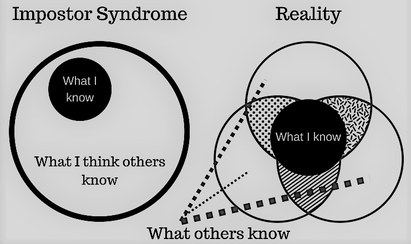
    What is imposter syndrome?

    According to the definitions I’ve explored, it is an internal dialogue that you are not as good as others see or perceive you to be. It can see success or accomplishment as something that was achieved through pure chance or luck, rather than talent or ability. It is linked with self-doubt and being inadequate.
     
    Yeah, I can relate to most of those definitions I’ve found and relate to them in some way or other, to the way I’ve felt in many situations over the years.

    I went and did a few online tests and the scores were pretty high (75-85% in favour of having imposter syndrome).

    When doing some of the tests, some of the questions really resonated with me. I find it hard to take compliments and usually try and deflect it, the same with praise when I’ve done something worthy, again deflect it. Things I’ve achieved, the same thing, deflection and not seeing it as a big deal.

    I’d like to think I’m a fairly driven individual – even with high levels of self-doubt. When I set myself goals or targets I achieve them. I don’t undertake these goals or targets with a complacent attitude and make sure I have done everything, so I am able to give it my best shot. I’m also aware of my limitations as well.

    I sometimes reflect on what I could have done better and focus on this rather than on what I have achieved. I rarely stop to reflect on what I have achieved and tend to move onto the next goal, the next opportunity to push myself, the opportunity to prove to myself I have that that constant drive. I’m not one to brag about my achievements. I set myself goals or targets to see how far I can push myself and at times it becomes an internal battle to quell the self-doubt. 

    On Monday I start another 14 months of study alongside my ‘day job’ – again those thoughts of ability and capability are there. Deep down though I know that I will eclipse this goal because I’ve done it countless times in the past, when the doubts have been there.


    Picture
    Picture